Battery Recycling in India: Process, Rules & Why It Matters
How lithium-ion and EV battery recycling actually works, what India's regulations require, and what materials are recovered.
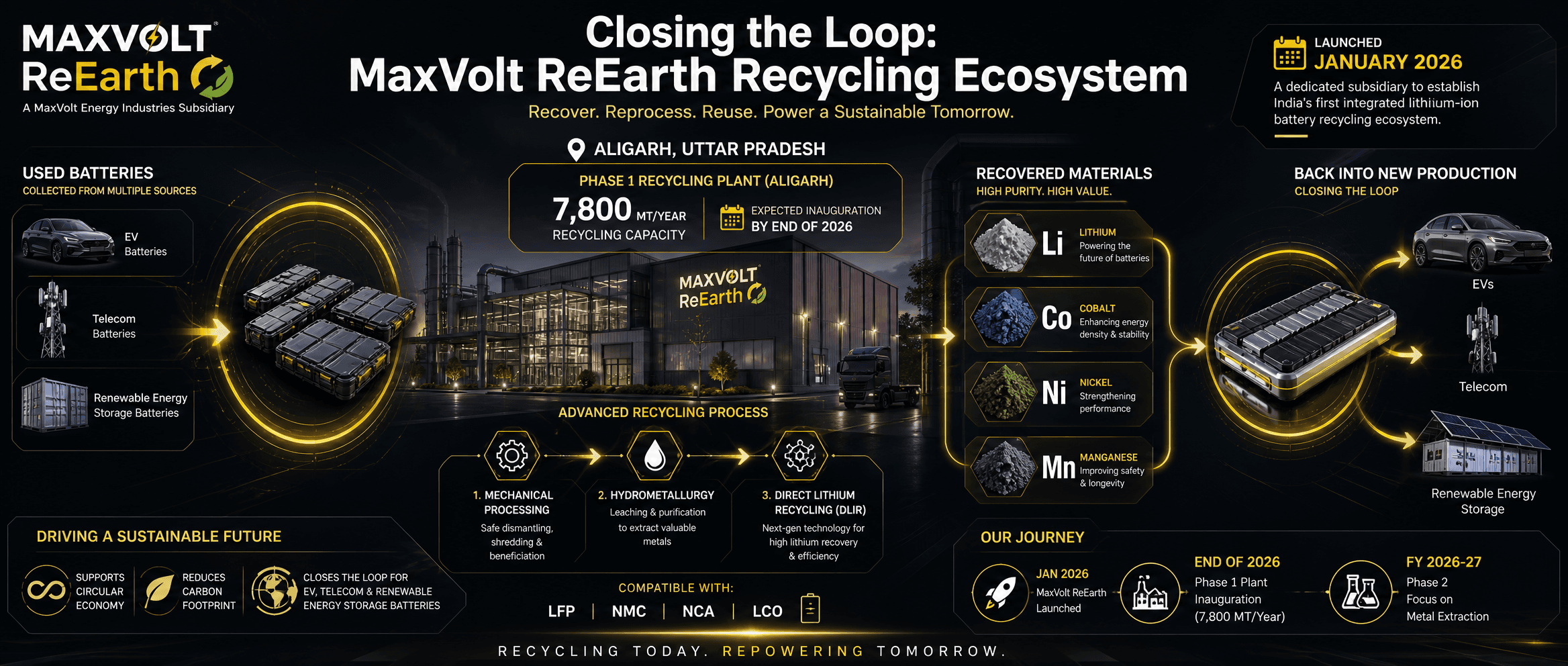
As India's EV and solar-storage adoption grows, so does the number of lithium-ion batteries that will eventually reach end of life — and what happens to them matters. Unlike lead-acid batteries, which have a mature, well-regulated recycling industry, lithium-ion recycling in India is still being built out, with both environmental stakes and a genuine economic opportunity in recovering critical minerals.
This page covers how the recycling process actually works, what India's regulatory framework requires, and why it's more than an environmental checkbox — it's how the critical minerals inside a battery (lithium, cobalt, nickel, manganese) get back into the supply chain instead of being mined again.
Why Battery Recycling Matters
A used lithium-ion battery isn't inert waste — cells can still hold residual charge and contain reactive materials that pose fire and contamination risks if discarded improperly. At the same time, the metals inside it (lithium, cobalt, nickel, manganese) are exactly what's needed to build the next generation of batteries, and India currently imports the vast majority of these raw materials.
Recycling closes that loop: it reduces environmental risk from improper disposal, cuts dependence on imported critical minerals, and lowers the overall carbon footprint of battery manufacturing compared with mining virgin material.
India's Regulatory Framework
The Battery Waste Management Rules, 2022 (notified by India's Ministry of Environment, Forest and Climate Change) apply Extended Producer Responsibility (EPR) to battery manufacturers — making producers responsible for the collection and recycling of batteries they place in the market, with mandated minimum recovery percentages for key materials.
This shifts battery recycling from a purely voluntary environmental initiative to a compliance requirement, and it's why manufacturers with genuine in-house or partnered recycling capability — rather than just a stated policy — are better positioned as the regulatory framework matures.
How the Recycling Process Works
Collection & discharge: used batteries are collected, tested, and safely discharged to remove residual energy before further processing — a critical safety step given the fire risk of a damaged, still-charged lithium cell.
Mechanical processing: batteries are shredded and separated into fractions — plastics, metals, and a metal-rich "black mass" that contains most of the recoverable lithium, cobalt, nickel and manganese.
Material recovery: the black mass is processed — typically through hydrometallurgical (chemical leaching) or direct lithium recycling methods — to extract battery-grade materials at high purity, which can then re-enter the supply chain as inputs for new cells.
Maxvolt's recycling subsidiary, Maxvolt ReEarth, operates on this model, with a facility in Aligarh, Uttar Pradesh designed to process multiple chemistries — LFP, NMC, NCA and LCO — rather than being limited to a single battery type.
Common Applications
Frequently Asked Questions
Can lithium-ion batteries actually be recycled?
Yes — lithium, cobalt, nickel and manganese can all be recovered from used lithium-ion cells through mechanical processing followed by chemical or direct extraction methods, and reintroduced into new battery production.
Is battery recycling mandatory in India?
Yes — the Battery Waste Management Rules, 2022 place Extended Producer Responsibility on battery manufacturers and importers, with mandated collection and material-recovery targets.
What happens to an EV battery when it can no longer power a vehicle?
A battery that's no longer suitable for a vehicle often still has meaningful capacity left. Depending on its condition, it may be assessed for second-life stationary storage use, or sent for recycling to recover its raw materials.
What does Maxvolt do with battery recycling?
Maxvolt's subsidiary, Maxvolt ReEarth, is building dedicated lithium-ion battery recycling capacity in Aligarh, Uttar Pradesh, designed to process multiple chemistries and recover lithium, cobalt, nickel and manganese for reuse.
Have a Question About Battery Recycling in India: Process, Rules & Why It Matters?
Talk to our team for sizing help, pricing, or technical guidance — no obligation.