What Is a Battery Management System (BMS)?
What a BMS does inside a lithium battery, its core functions, and why it matters as much as the cells themselves.
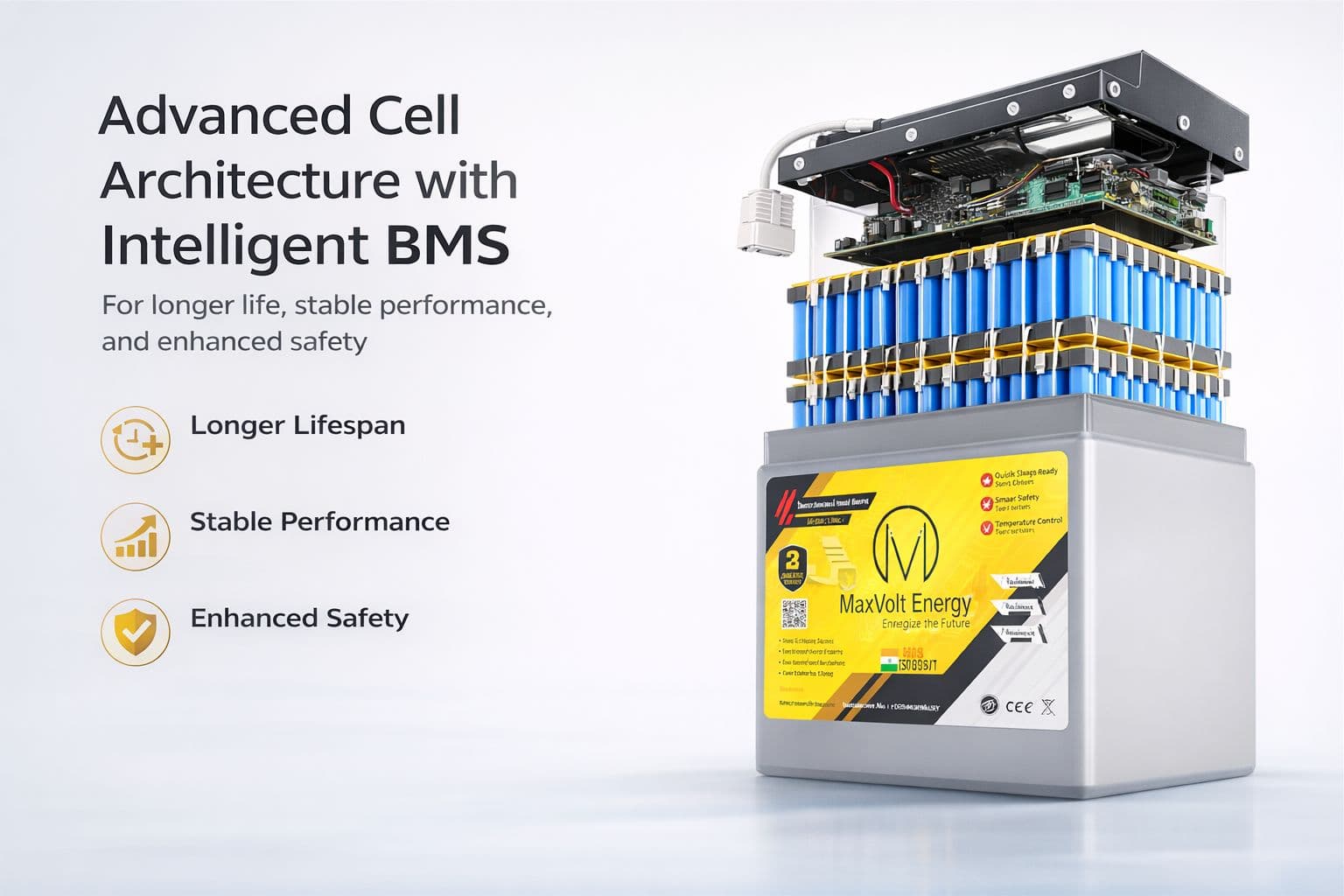
When people compare lithium batteries, they usually look at voltage and amp-hours first. But the component doing the most work to keep that battery safe and long-lived rarely gets mentioned: the Battery Management System, or BMS — the electronic system sitting between the battery cells and the outside world.
A BMS isn't optional hardware bolted on for marketing — without one, a multi-cell lithium pack has no protection against the failure modes (overcharge, over-discharge, short circuit, thermal runaway) that cause the fires and premature failures lithium batteries are sometimes associated with in the news.
The Four Core Functions of a BMS
Voltage protection prevents overcharging past a cell's safe ceiling and stops discharge before cells are drained too deep — both of which shorten lifespan dramatically if left unmanaged, and can create safety risks if pushed far enough.
Current protection cuts power instantly if a short circuit or overcurrent event is detected, protecting both the battery and the connected equipment's wiring.
Temperature monitoring shuts down or throttles the pack if cells run hotter than safe limits, guarding against thermal runaway — the failure mode behind most publicized lithium battery fire incidents.
Cell balancing is the quieter but equally important job: in a multi-cell pack, individual cells drift out of sync over hundreds of charge cycles. A BMS actively redistributes charge across cells so the whole pack ages evenly, instead of the weakest cell dragging down the usable capacity of the entire pack years early.
Why Two Identical-Spec Batteries Can Perform Very Differently
Two batteries with the same voltage and capacity on paper can have completely different real-world lifespans depending on BMS quality. A pack with a robust BMS protects your investment cycle after cycle; a pack with a cheap or absent BMS is effectively a ticking clock, regardless of how good the cells inside it are.
This is why evaluating a lithium battery purchase should include asking about the BMS as seriously as the cell chemistry — protection thresholds, whether balancing is active or passive, and whether the BMS is application-tuned (e.g. for vehicle vibration and variable discharge) rather than generic.
Smart & Cloud-Connected BMS
Beyond the four core protective functions, higher-end BMS platforms add remote monitoring — state of charge, temperature trends, fault history and location — accessible via a mobile app, plus predictive alerts before a fault actually occurs. For fleets and commercial installations, this turns the BMS from a passive safety component into an active maintenance and asset-management tool.
Common Applications
Frequently Asked Questions
Is a BMS the same as a battery charger?
No — a charger supplies power to the battery; the BMS is an internal protection and monitoring system that manages how the cells charge, discharge, and balance against each other, whether or not a charger is connected.
Can a lithium battery work without a BMS?
A single-cell device might get away without one, but any multi-cell lithium pack (which covers essentially all EV, inverter and solar batteries) needs a BMS for safe operation — without it, cells can overcharge, over-discharge or drift dangerously out of balance.
Does a better BMS cost more?
Generally yes — active balancing, comprehensive protection thresholds and cloud connectivity add cost over a basic passive-protection BMS, but that cost typically pays back through a longer, safer, more predictable battery life.
What BMS does Maxvolt use?
Maxvolt batteries ship with an application-tuned Smart BMS covering overcharge, over-discharge, over-temperature and short-circuit protection with active cell balancing; select product lines add cloud-connected monitoring.
Have a Question About What Is a Battery Management System (BMS)??
Talk to our team for sizing help, pricing, or technical guidance — no obligation.