Battery Terminology Glossary: Voltage, Ah, Wh, C-Rating & More
Plain-English definitions and worked examples for the battery terms that actually matter when reading a spec sheet.
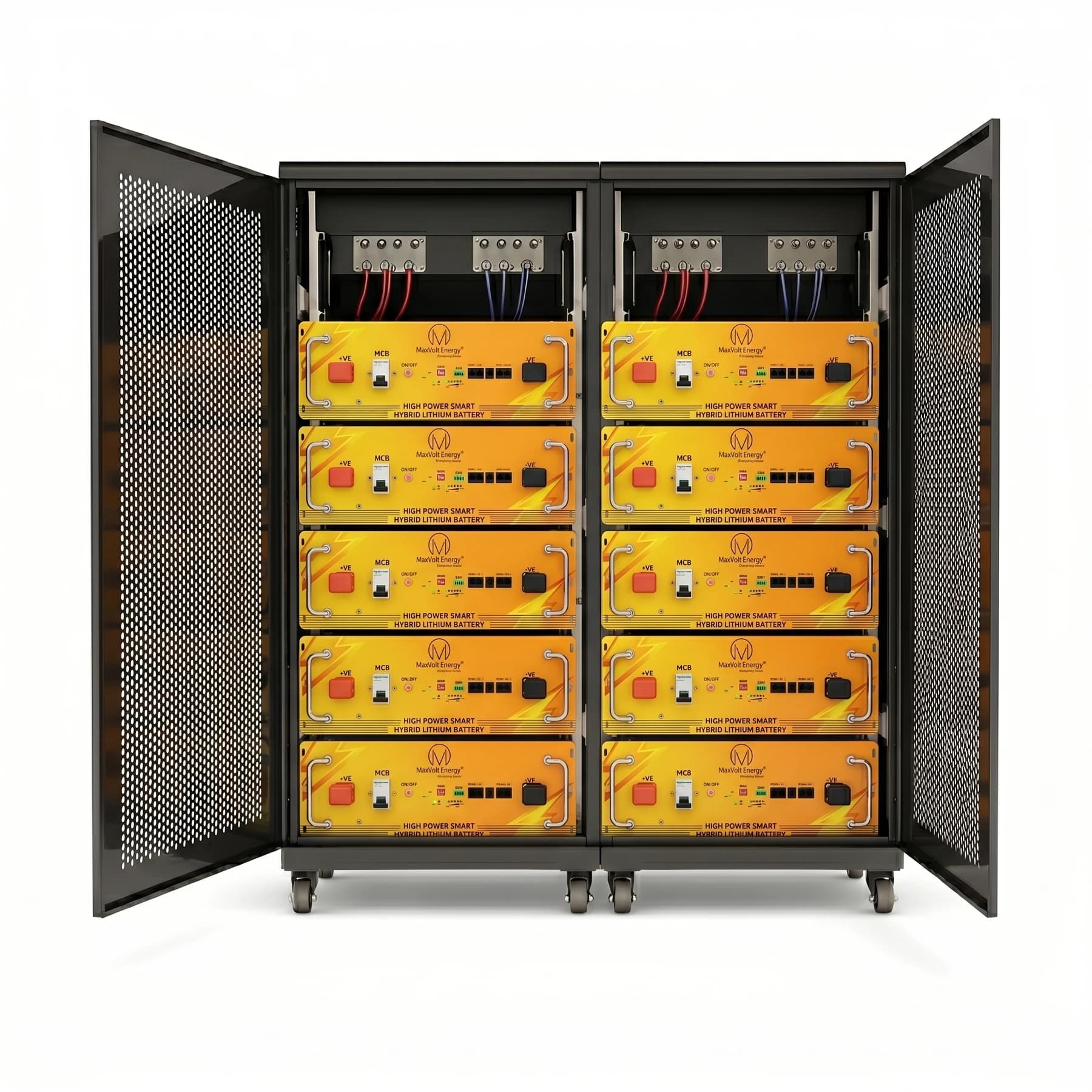
Battery spec sheets are full of abbreviations that matter for very practical reasons — the difference between Ah and Wh determines whether you can actually compare two batteries of different voltage, and knowing what "C-rating" means tells you whether a pack can handle your equipment's peak power draw. This page covers the terms in one place, with real worked examples, rather than scattering one-line definitions across a dozen thin pages.
Voltage (V)
Voltage is the electrical "pressure" a battery outputs — it needs to match what your equipment is designed for. Common lithium pack voltages include 12.8V, 25.6V and 51.2V for inverters/solar, and 48V–74V for two-wheelers, 51.2V for e-rickshaws. Using the wrong voltage isn't just inefficient — it can damage equipment or fail to work at all, so voltage is always the first spec to match.
Amp-Hour (Ah) & Watt-Hour (Wh)
Ah (amp-hour) measures how much current a battery can deliver over one hour — but Ah alone can't be compared across batteries of different voltages, because it doesn't capture total energy. Wh (watt-hour) does: Wh = Voltage × Ah.
Worked example: a 51.2V 100Ah battery stores 51.2 × 100 = 5,120 Wh (5.12 kWh). A 25.6V 100Ah battery — same Ah rating — stores only 25.6 × 100 = 2,560 Wh, exactly half as much energy. This is why comparing two batteries by Ah alone is misleading unless their voltage is identical; Wh is the true "how much energy" number.
Kilowatt-Hour (kWh)
kWh is simply Wh ÷ 1,000 — used because most household and commercial energy is billed and discussed in kWh ("units" on an Indian electricity bill are kWh). A 5,120 Wh battery is a 5.12 kWh battery — the same number, different unit for convenience at larger scale.
C-Rating
C-rating describes how fast a battery can safely charge or discharge, relative to its capacity. A 1C discharge rate means the battery can be fully discharged in 1 hour; a 2C rate means it can discharge twice as fast (in 30 minutes) without damage. For a 100Ah battery, a 1C discharge rate means it can safely deliver 100A continuously; a 0.5C rate means a maximum of 50A. Equipment with high peak power draw (like power tools or performance EVs) needs a battery with a correspondingly high C-rating, not just adequate Ah.
State of Charge (SOC)
SOC is simply the battery's current charge level, expressed as a percentage of full capacity — the same concept as a fuel gauge. 100% SOC is fully charged, 0% is fully discharged. The BMS tracks this continuously and is what your app or display is reading when it shows a charge percentage.
State of Health (SOH)
SOH measures how much of the battery's original capacity remains after use and aging, expressed as a percentage. A battery at 85% SOH can now only store 85% of the energy it could when new — this is the metric that actually reflects long-term degradation, distinct from SOC (which resets every charge cycle). A battery can show 100% SOC (fully charged right now) while having dropped to, say, 80% SOH (its maximum capacity has shrunk over time).
Depth of Discharge (DoD)
DoD is how much of a battery's capacity has been used in a given discharge cycle, expressed as a percentage — the inverse of remaining SOC. Discharging from 100% to 20% SOC is an 80% DoD cycle. Lithium batteries (especially LiFePO4) tolerate deep discharge far better than lead-acid, which is why lithium cycle-life ratings are typically quoted at 80–100% DoD, while lead-acid is usually rated at only ~50% DoD to achieve reasonable lifespan.
Series vs Parallel Connection
Connecting cells or batteries in series adds their voltages together while capacity (Ah) stays the same — two 12.8V 100Ah batteries in series produce 25.6V at 100Ah. Connecting in parallel adds capacity (Ah) together while voltage stays the same — two 12.8V 100Ah batteries in parallel produce 12.8V at 200Ah. Multi-module rack systems typically use a combination of both to reach a target voltage and capacity simultaneously.
Cell Chemistry (LFP / NMC)
The two chemistries you'll encounter most in Indian EV and storage batteries. See our full LFP vs NMC comparison for the detailed breakdown — in short, LFP (LiFePO4) prioritizes cycle life and thermal safety, NMC prioritizes energy density and lighter weight.
Battery Degradation & Thermal Management
Degradation is the gradual, expected loss of capacity (and rise in internal resistance) every lithium battery experiences over its charge cycles — SOH is how this is measured. Heat is the biggest accelerant of degradation beyond normal cycling, which is why thermal management (keeping cells within their rated temperature range during charge, discharge and storage) is a core BMS function, not an optional extra. See our battery management system guide for how this is actually implemented.
Frequently Asked Questions
How do I convert Ah to Wh?
Multiply amp-hours by voltage: Wh = V × Ah. A 51.2V 100Ah battery stores 51.2 × 100 = 5,120 Wh (5.12 kWh).
What's the difference between SOC and SOH?
SOC (State of Charge) is how full the battery is right now, as a percentage — it resets every charge. SOH (State of Health) is how much total capacity the battery has left compared to when it was new — it only decreases over the battery's life.
Why does C-rating matter if my battery has enough Ah?
Ah tells you total capacity, but C-rating tells you how fast that capacity can be delivered. A battery can have plenty of total capacity but still be unable to supply a high peak power draw if its C-rating is too low for the application.
Is 80% depth of discharge safe for a lithium battery?
Yes, for LiFePO4 in particular — lithium cycle-life ratings (2,000–3,500+ cycles) are typically quoted at 80% DoD or higher, unlike lead-acid, which needs to be limited to roughly 50% DoD to achieve reasonable lifespan.
Have a Question About Battery Terminology Glossary: Voltage, Ah, Wh, C-Rating & More?
Talk to our team for sizing help, pricing, or technical guidance — no obligation.